%20(8).png?width=300&height=300&name=Body%20(300%20x%20300%20px)%20(8).png)
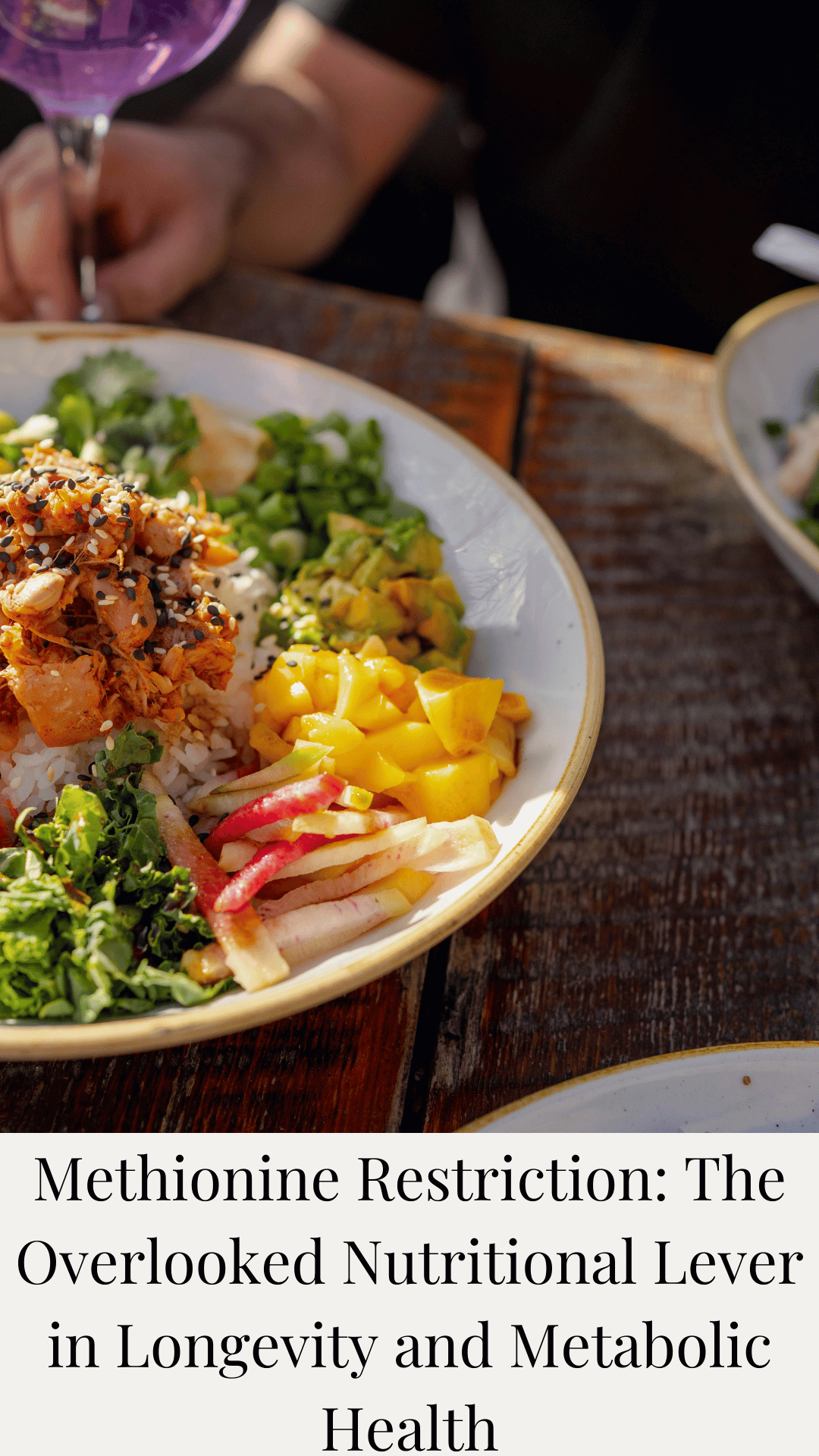
Methionine Restriction: The Overlooked Nutritional Lever in Longevity and Metabolic Health

A science-based perspective on how a single amino acid may influence aging, metabolic function, cancers, and disease pathways.
What if longevity wasn’t just about eating less—but about a single amino acid and changing at the molecular level?
For decades, research has focused on calorie restriction as the gold standard for extending lifespan. But emerging evidence suggests that what you restrict may matter more than how much you restrict.
One nutrient, in particular, is drawing increasing attention:
Methionine.
And even more compelling is its relationship to what researchers have described as:
The Hoffman Effect
What the Research Shows
Studies found in PubMed suggest that restricting methionine, a single essential amino acid, may reproduce many of the benefits traditionally associated with caloric restriction.
A foundational study published in Annals of the New York Academy of Sciences found that:
Methionine restriction can extend lifespan across multiple organisms, even without reducing total calorie intake.
This is a critical distinction.
It suggests that longevity may not be driven solely by energy intake—but by specific metabolic signals influenced by nutrients.
This Is A Shift Beyond Calories: A New Nutritional Paradigm
Traditional models of longevity focus on:
- Caloric restriction
- Fasting
- Energy balance
However, these approaches can be difficult to sustain and may carry risks if not properly managed.
Methionine restriction introduces a different paradigm:
A Targeted nutrient modulation
Instead of restricting food broadly, it focuses on adjusting amino acid composition, particularly from high-methionine sources such as animal proteins and grains toward longevity inducing plant based foods.
What Is Methionine Restriction?
Methionine is an essential amino acid required for:
- Protein synthesis
- Methylation reactions
- Cellular growth
However, research suggests that excess methionine intake—common in modern diets—may overstimulate growth pathways and metabolic processes linked to aging and disease.
Methionine restriction (MR) reduces intake of high-methionine foods—primarily animal proteins—while emphasizing plant-based sources.
One of the most intriguing findings in metabolic research is the observation that certain cells exhibit methionine dependence—a phenomenon widely studied by Robert M. Hoffman.
This has been referred to as the Hoffman Effect.
What they have found:
Some rapidly proliferating cells, such as cancers, are unable to grow or survive when methionine availability is limited—even when other nutrients are present.
This contrasts with normal cells, which are more metabolically flexible.
Key Insight:
Methionine dependence may represent a metabolic vulnerability—one that could potentially be influenced through dietary strategies.
Studies indexed in PubMed describe this phenomenon:
- Hoffman RM. “Methionine dependence of cancer and aging.”
- Stern PH, et al. Research demonstrating methionine-dependent growth patterns
- Preclinical studies showing tumor growth suppression under methionine restriction conditions
While much of this research is still evolving, it has contributed to growing interest in targeted amino acid nutrition.
Why Methionine Matters To Longevity and Disease
Emerging research highlights several biological mechanisms through which methionine may influence aging and disease.
1. Methylation and Gene Expression
Methionine is a precursor to S-adenosylmethionine (SAM), a key molecule involved in:
- DNA methylation
- Gene regulation
Excess methionine may influence epigenetic signaling, which plays a role in aging and disease progression.
2. Oxidative Stress Reduction
Methionine metabolism is closely linked to oxidative processes in the body. (We know it as free radicals.)
Studies indicate that methionine restriction may:
- Reduce mitochondrial reactive oxygen species
- Improve cellular resilience
- Support metabolic health
(PubMed: Orentreich et al.; Lee et al.)
This is significant because oxidative stress is a major contributor to:
- Aging
- Chronic disease
- Cellular dysfunction
3. mTOR and Growth Signaling
Methionine availability influences nutrient-sensing pathways such as mTOR, which regulates:
- Cell growth
- Protein synthesis
- Aging processes
Lower methionine intake may help modulate these pathways as much as calorie restriction.
4. Autophagy and Cellular Repair
Reduced methionine intake has been associated with increased autophagy—the body’s natural process of clearing damaged cells.
This is a key mechanism in:
- Longevity
- Disease prevention
- Cellular renewal
Lower methionine intake can promote cellular renewal processes, which are associated with improved longevity outcomes.
5. Hormonal and Metabolic Adaptation
Animal studies show that methionine restriction can:
- Improve insulin sensitivity
- Reduce fat accumulation
- Increase beneficial metabolic hormones
- Decrease Homocysteine (a toxic metabolite)
In one model, reduced methionine intake led to improvements in lipid metabolism and insulin regulation, even without reducing calorie intake. Reducing methionine intake decreases Homocysteine leading to reduced inflammation, and increased mental clarity and brain health.
While the research is very promising spanning across decades, several important points must be acknowledged:
- Human long-term studies are still developing
- Nutritional balance is critical and Supplementing B Vitamins can be important
- Some of the data comes from preclinical and animal studies
- Zuckerburg Chan has funded significant studies
- Methionine studies are not funded by the pharmaceutical industry
Longevity Without Starvation?
One of the most compelling implications of this research is that:
Lifespan extension may be achievable without severe calorie restriction. Methionine restriction can extend lifespan in animal models without reducing total calorie intake.
(Orentreich et al., J Nutr, 1993; Miller et al., Aging Cell)
This suggests that nutrient composition, not just caloric intake, plays a central role in longevity.
This represents a major shift in how we think about diet and longevity.
Instead of:
- Eating less
We may need to focus on:
- Eating strategically
Where Methionine Comes From
High-methionine foods:
- Meats and animal products
- Eggs
- Dairy
- Grains
Lower-methionine foods:
-
Fruits
-
Vegetables
-
Legumes
-
Seeds and Nuts
This aligns with dietary patterns often associated with longevity.
While protein is essential for health, modern diets often provide it in excess, especially in Western dietary patterns. It is possible to eat plant-based, low methionine, and ketogenic. It just takes learning the right foods.
In contrast, plant-based proteins tend to be:
- Lower in methionine
- Higher in fiber and phytonutrients
- More aligned with longevity-associated dietary patterns
Note: Other foods are high in methionine such as grains. Grains are grass seeds so quinoa, amaranth, and other non-grass seeds like buckwheat can be easily substituted.
This is about optimization.
This Is A New Direction in Preventative Health
Methionine restriction represents a broader shift toward:
- Precision nutrition
- Metabolic targeting
- Prevention-focused healthcare
- The Hoffman Effect
- Longevity science
It aligns with a growing recognition that:
Chronic disease is often rooted in metabolic dysfunction
And metabolism is heavily influenced by dietary composition.
We are entering a new era in nutrition science—one that moves beyond calories and into cellular-level decision making.
Points toward a future where nutrition is not just about fuel—but about cellular signaling and metabolic precision.
Methionine restriction is not a trend.
It is a research-backed doorway into understanding how food influences:
- Aging
- Disease
- Longevity
We are moving into an era where diet is understood not just in terms of calories—but in terms of biological instructions.
· Methionine restriction represents one of the most compelling examples of this shift.
It invites a new question:
What if the key to longevity lies not in eating less—but in eating with metabolic intention?
If you want more information:
Download Our Kids Coloring Book Free
Unleashing Your SuperPower…Starving Cancer Cells
Read the Book
Starve Cancer and Feed Longevity
If you want a practical step by step guide to easily eating low methionine see
Money & Time Saving Meal Planning Guide
#Longevity #NutritionScience #PreventativeHealth #MetabolicHealth #Aging #FunctionalMedicine #Biohacking #Wellness #CancerResearch